
Supreme Court Tariff Ruling, AI, and Iran
February is a reminder to investors that markets never move in a straight line. After January's positive momentum carried major indices to new all-time highs, the mood shifted due to a landmark Supreme Court ruling on tariffs, concerns around artificial intelligence, softer labor market data, and major escalations in the Middle East. Meanwhile, international stocks and small caps continued to outperform, and bonds saw further gains, highlighting the importance of holding a balanced portfolio.
While headlines can create short-term volatility, the overall economy remains healthy and corporate earnings continue to grow. Rather than reacting to any single development, investors are best served by maintaining a diversified portfolio aligned with their financial goals.
Key Market and Economic Drivers in February
The S&P 500 fell -0.9% and the Nasdaq Composite dropped -3.4% for the month. Meanwhile, the Dow Jones Industrial Average rose 0.2%.
The CBOE VIX volatility index increased to 19.9 at the end of the month due to AI-related concerns and trade policy uncertainty.
International developed markets jumped 4.5% based on the MSCI EAFE Index in US dollar terms, while emerging markets gained 5.4% based on the MSCI EM Index. Year-to-date, they have gained 9.9% and 14.6%, respectively.
U.S. small cap stocks gained 0.7% based on the Russell 2000.
The 10-year Treasury yield ended the month lower at 3.95%. This is the first month it has fallen below 4% since last November. The Bloomberg Aggregate Bond Index rose 1.6%.
Gold closed lower at $5,279 per ounce but reached as low as $4,661 at the beginning of the month. Silver ended lower at $93.79 per month.
The U.S. dollar index rose slightly to 97.6.
January inflation showed headline CPI at 2.4% year-over-year and core CPI at 2.5%, while the core PCE price index rose 0.4% month-over-month, the sharpest increase in a year.
The unemployment rate edged down to 4.3% in January, with 130,000 nonfarm payroll jobs added. However, annual benchmark revisions showed the economy created only 181,000 jobs in all of 2025, roughly 15,000 per month.
On February 20, the Supreme Court ruled against the administration's use of IEEPA-based reciprocal tariffs, prompting a pivot to alternative trade laws.
On February 28, the U.S. and Israel launched military strikes against Iran, including the compound of Iran’s Supreme Leader who has been reported killed.
A Supreme Court ruling reshapes trade policy
The most significant policy development in February was the Supreme Court's ruling on February 20 against the administration's tariffs. These were originally enacted based on the International Emergency Economic Powers Act (IEEPA) to impose reciprocal tariffs against most trading partners. The decision has broad implications, including potential refunds to businesses and consumers.
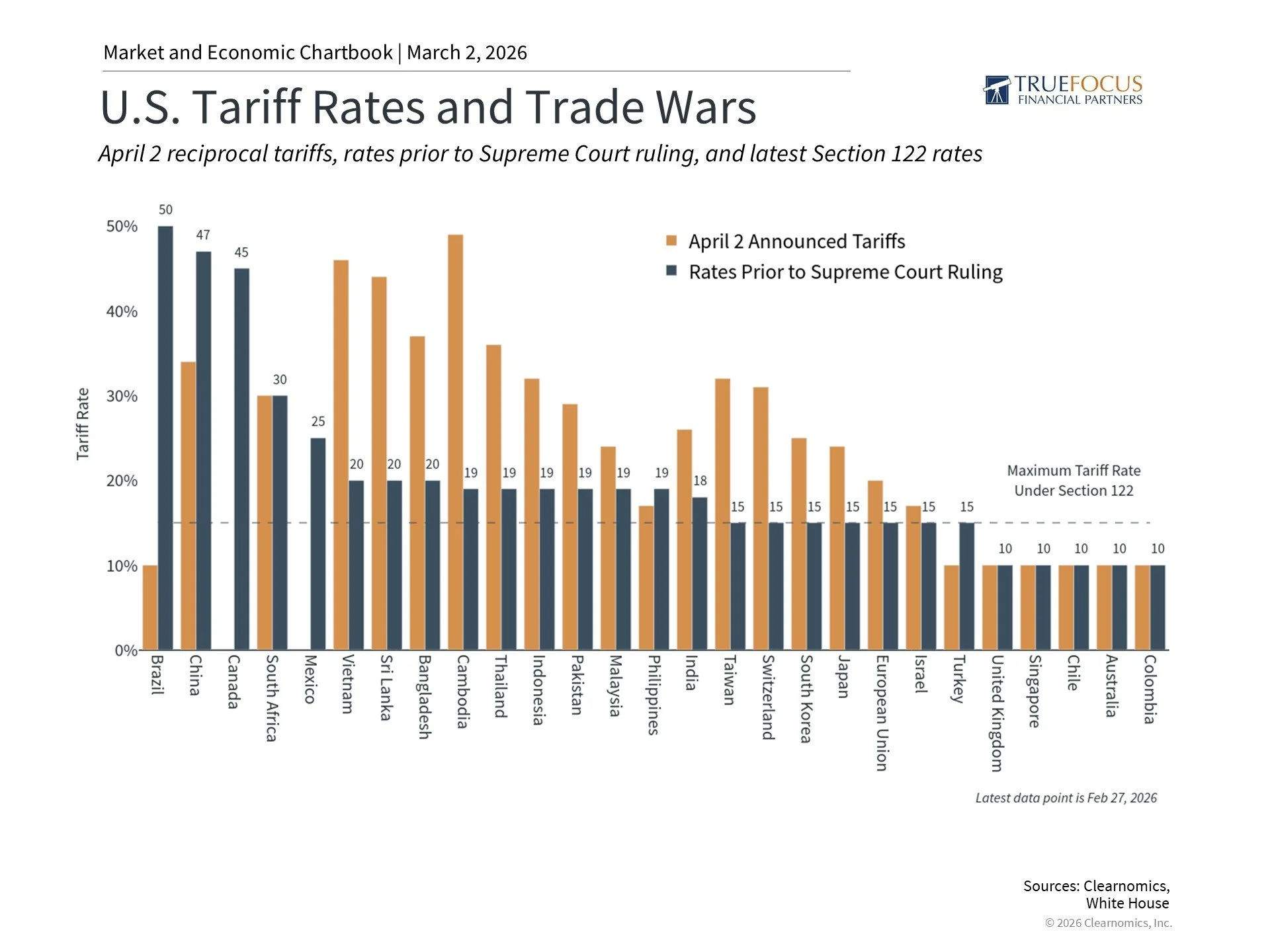
Following the ruling, the White House quickly adjusted tariffs based on another law, Section 122 of the Trade Act of 1974, which allows the president to impose tariffs of up to 15% for 150 days. These new import duties went into effect on February 24. The administration is also expected to pursue other measures, including Section 301 of the Trade Act of 1974 for unfair trade practices and Section 232 of the Trade Expansion Act of 1962 for national security-based restrictions.
For investors, the key takeaway is that while the legal framework for tariffs has shifted, the policy direction has not. Trade uncertainty will continue to generate headlines and contribute to market volatility. However, as history has shown, markets tend to adjust to new trade realities over time, especially as companies adapt their supply chains and pricing strategies.
The Treasury yield curve reflected some of this uncertainty, with the 10-year yield briefly falling below 4% for the first time since November. This dynamic helped fixed income portfolios in February and is a reminder of why bonds play an important role in balanced portfolios.
AI enthusiasm versus valuations
AI continued to dominate market conversations in February, but the narrative shifted from high valuations to a debate about the pace and degree of disruption on existing business models. Some investors worry that AI agents could compress software margins, accelerate white-collar displacement through automation, and disrupt traditional business models faster than expected.
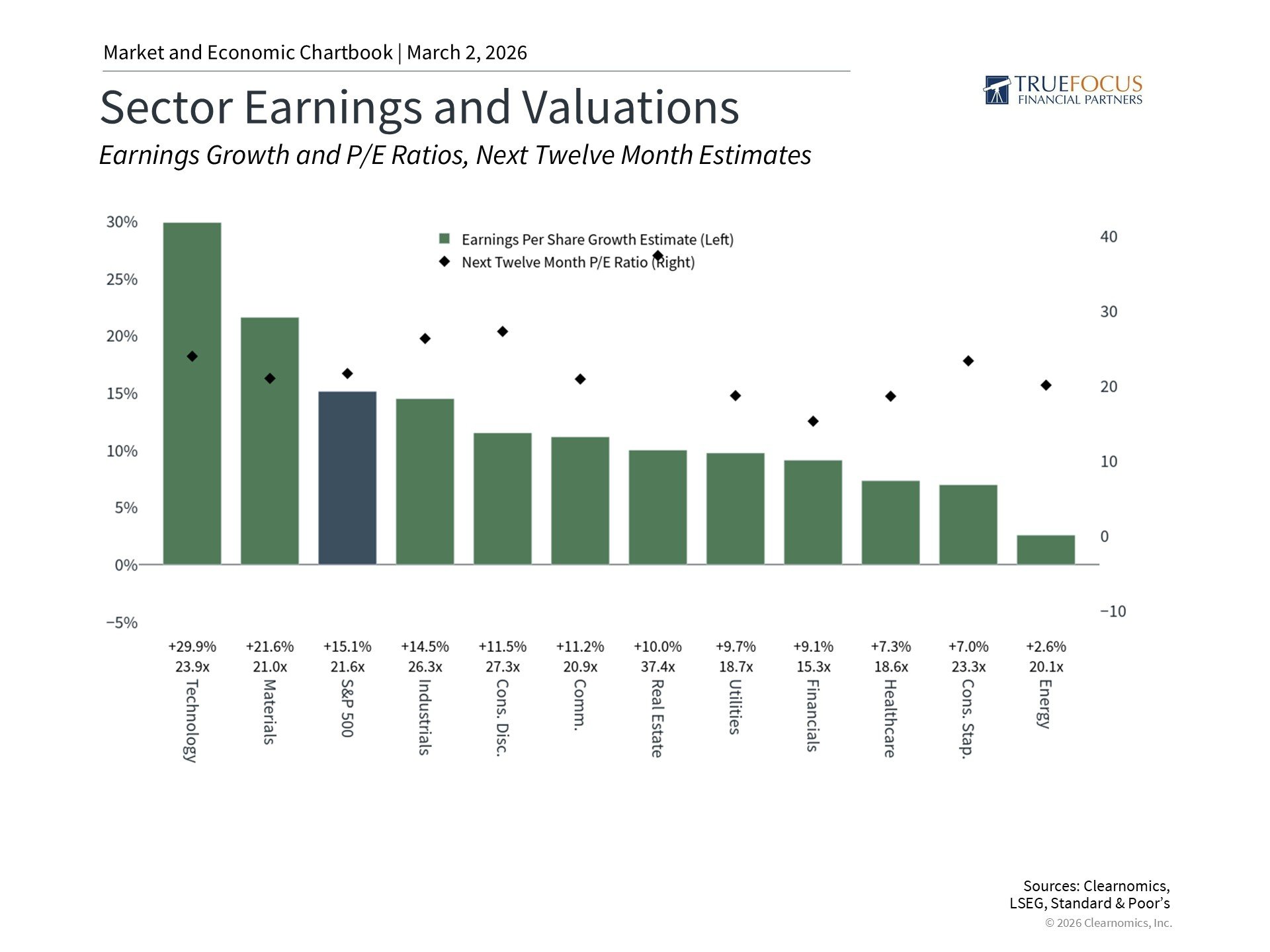
These concerns have contributed to a notable market rotation. Investors have been diversifying away from mega-cap technology stocks and toward sectors perceived as harder to displace, including energy, materials, and industrials. This shift, sometimes described as a move toward "heavy assets, low obsolescence" (HALO) companies, helps explain why the Nasdaq underperformed while other parts of the market rallied.
While market volatility can be unpleasant, this is a healthy development for long-term investors who have been concerned about the rising level of stock market valuations.
Growth cooled while the labor market sent mixed signals
According to the Bureau of Economic Analysis, real GDP increased at an annual rate of 1.4% in the fourth quarter of 2025, down from 4.4% in the prior quarter and below market expectations of 2.5%. The slowdown was partly due to the record-long government shutdown and a deceleration in consumer spending. However, business investment grew 3.7% on an annualized basis, driven by record-setting investments in AI data centers. For all of 2025, real GDP grew 2.2%, which remains healthy by historical standards.
Perhaps more concerning is the state of the labor market. While the unemployment rate edged down to 4.3% in January, annual benchmark revisions from the Bureau of Labor Statistics painted a much weaker picture. The economy created only 181,000 jobs in 2025, translating to roughly 15,000 per month.
This has led some economists to describe the current environment as one of "jobless growth," a situation where the economy expands but job creation fails to keep pace. The divergence between GDP growth and employment has been widening since mid-2022, and it raises questions about the underlying quality and breadth of the current expansion.
International stocks and small caps led the way
One of the most notable developments in February was the continued outperformance of asset classes beyond U.S. large-cap stocks. International developed markets rose nearly 5% for the month, while emerging markets gained over 5%. U.S. small caps posted their strongest monthly gain since August, with the Russell 2000 surging roughly 5% year-to-date, far outpacing the S&P 500.
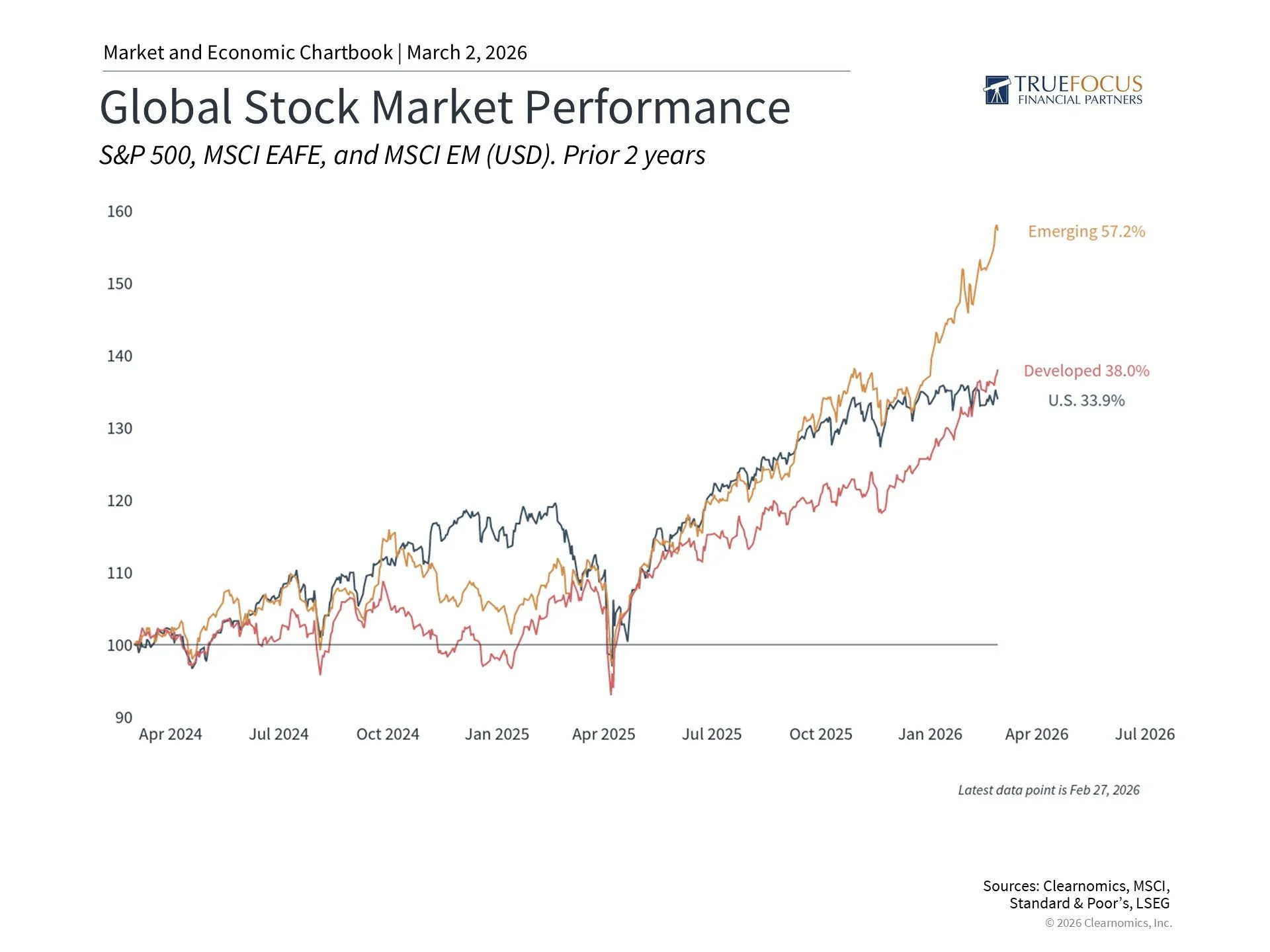
This broadening of market returns is significant for diversified investors. After several years where only a small number of large U.S. technology companies drove the majority of market gains, the shift toward international stocks, small caps, and cyclical sectors suggests that investors are finding opportunities across a wider range of assets. A weaker dollar earlier in the year has also helped boost international returns when converted back to U.S. dollar terms.
Precious metals continued their strong run as well, with gold and silver gaining 6.8% and 8.1%, respectively. These gains reflect a combination of geopolitical uncertainty, central bank purchases, and concerns about fiscal deficits. While precious metals can play a role in diversified portfolios, January's sharp reversal is a reminder that they can experience significant volatility.
Another major development that occurred at the end of February was the escalations in the U.S.-Iran conflict which intensified amid strikes across the Middle East and reports surrounding the death of Iran’s supreme leader, Ali Khamenei. While the situation is still playing out and geopolitical uncertainty can create concerns, history shows that staying invested has been the best approach to navigating these periods.
The bottom line? February's U.S. stock market performance was offset by strength in international markets, small caps, and bonds. While AI and trade policy uncertainty will continue to generate headlines, the broadening of market leadership is a positive development for long-term investors.